Virtually EVERY powered airplane built, at full takeoff power, at sea level, on a cold and dry day, with a long enough runway and with standard takeoff trim and flaps set, has sufficient angle of incidence to take to the air without ANY rotation.
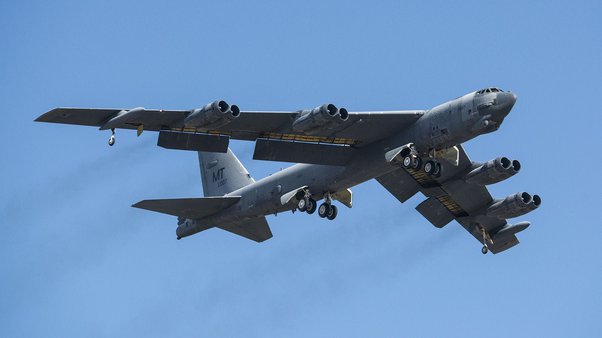
Ron’s posted video shows a BUFF at full takeoff power with a teensey-weensey “apparent” rotation just prior to liftoff. Every bit of angle helps the aircraft to lift off sooner rather than later. But I’d bet my next paycheck that the B-52 could lift off unassisted given the conditions I stated. I welcome refutation.
Not part of an answer to the original question but still relevant to the question: There are many reasons why pronounced take-off rotation would be adverse to a given aircraft design’s purpose. One is landing gear loading.
The BUFF provides an example. It’s two sets of landing gear are set inline with the fuselage and well forward and aft of the wing’s center of moment. Excessive takeoff rotation might put excessive downward force on the rear landing gear set, damaging it. The BUFF’s fuselage is also very long. Excessive rotation would increase the chance of tail strikes.
High speed jets are purposefully designed with as low an angle of incidence (angle between wing chord line and the longitudinal axis of the aircraft) as possible. This is to minimize induced drag at the design operational speed envelope. Eats less gas and increases operational range.
One interesting design is the US Navy’s old F-8 Crusader. It was a carrier-based supersonic fighter-bomber. The wing’s could be rotated “upward” for takeoffs and landings. And at cruise speed, it could be lowered. This allowed higher operational speed while affording adequate lift during lower speed takeoff and landing.
The upward-rotated wing can be seen in the video below. Also, the Crusader was designed with a much taller nose gear than its main gear, so the jet’s longitudinal axis was not parallel to the “runway”. This design added more angle of incidence at takeoff to get off the deck and keep from flying into the sea.
The Crusader also had a very powerful engine with an almost 1:1 thrust to weight ratio. BUFFs have much less than 1:1 T/W. The effect is that an F-8 pilot can power their way out of a takeoff stall much easier than a BUFF pilot.
Its a direct result of the way the wing is attached to the fuselage.
The B-52s wing has a positive angle of incidence, meaning the wings leading edge is higher than its trailing edge in relation to the long axis of the fuselage.
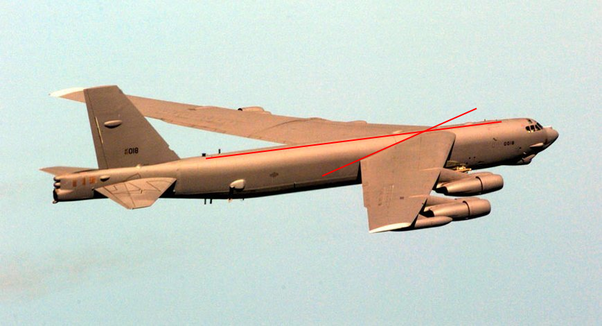
That positive angle of incidence also results in a positive angle of attack once air starts flowing over the wing even though the fuselage is still level with the ground.
If you need, say, a 15 degree angle of attack for liftoff for a similar size aircraft, then the pilot has to raise the nose a considerable amount to get the wings at 15 degrees.
On the B-52, since the wings area already at, say, 12 degrees just sitting on the ground, the nose only has to come up very slightly to get the wings to achieve 15 degrees for liftoff.