One problem for your scenario is that any modern (for the time) Allied fast battleship (like Iowa, S Dakota, or North Carolina, and several RN battleships) had a very robust (for the time) surface radar. Those warships are going to “see” the iceberg many miles away.
Unless the entire watch is COMPLETELY braindead the ship will go around it. No muss, no fuss. And there is just no getting away from that reality.
If it DOES hit then the entire watch and the captain will stand for a review board and be removed from the service. I mean, how incompetent can you get! So THAT answers your question, the ship is NOT going to sink, 0 chance.
First, the Titanic’s hull ruptured because its hull rivets sheared off.
But the Iowa class had welded hulls, so the hull is MUCH stronger, MUCH thicker, and thus will never “open up”. Guys are thrown out of bunks perhaps, but that just means there is a crowd around medic stations around the ship fixing cuts and bruises.
Since the hull is not breached it doesn’t matter that the ship has an order of magnitude more watertight doors, is peppered with watertight compartments, is a warship that has been designed assuming it will sustain damage, and that the entire crew drills on damage control routinely.
The ship sustains some hull deformation. It goes to drydock and is fixed. And the watch as well as the Captain face a review board and are booted from the service.
There’s certainly ways of interpreting the question, which would result in more nuanced and detailed answers being required, but here’s one variation with a clear-cut answer:
if Iowa’s hull were breached in the same places as Titanic, she would have not have sank, and would have been able to limp to safety under how own power.
I say this solely because of the one additional feature that battleships such as Iowa possessed, which was an armored citadel.
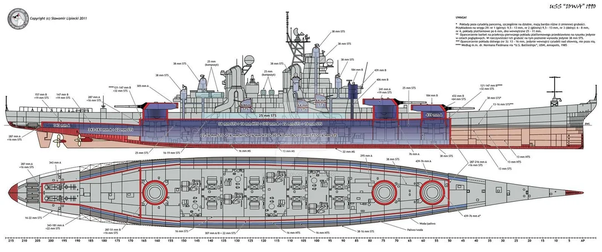
Post-WW1 battleships usually chose to concentrate all of their armor budget in a tight box around the center of the ship, known as a citadel. The citadel would contain all of the magazines as well as the engine rooms, all of the critical elements needed for essential survival.
The idea was that, even if the entire rest of the ship was completely lost and flooded, there was enough reserve buoyancy in the citadel to keep the ship afloat.
Long story short — because the iceberg took out the forward compartments of the Titanic, if Iowa lost those same compartants, she would survive. The damage would not reach the citadel, and even if it did, the iceberg would have a far far harder time breaching it.
So the Iowa would survive, simply because this was exactly what she was designed to survive.