Knowledge

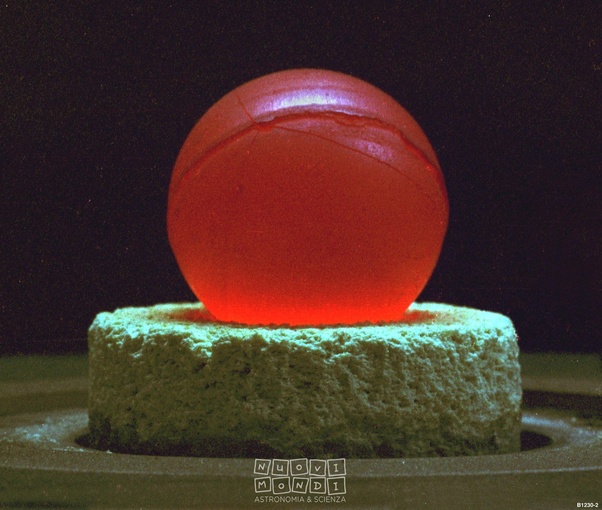
Here is A ball of Plutonium, be careful.

What you are seeing is a sphere of plutonium-238. In general, plutonium is not red, it is the usual metallic color. However, the 238 isotope undergoes natural decay which releases enough thermal energy to make it glow and red in color.

Plutonium 238 decays with a half-life of approximately 88 years. It means that one kilo of this isotope, after having irradiated uninterruptedly for 88 years, will have transformed half of its mass into other elements, while the other half will continue its radiation work, reducing to 250 grams after another 88 years, and so Street.

The heat produced during the decay of plutonium-238 can be used in the propulsion or energy production systems of space systems. Contrary to what one might think, the radiation emitted is not dangerous for health.

The particles emitted are exclusively of the alpha type (effectively helium ions) which cannot penetrate human skin. If ingested or inhaled, however, it is lethal.

Related Posts

What’s it like inside an aircraft carrier during a heavy storm?

During my time on a carrier, we went through a hurricane not once, but twice. We were in the Atlantic returning to our home port but first, we…

If the Soviets had decided to push the Allies out of Western Europe at the end of WW2, could they have done it?

Stalin asked Marshal Zhukov that very question in 1945. His answer: No. Westerns have a myth about the Red Army being this enormous inexhaustible machine that steamrolled its…

How long can an Ohio-class submarine stay submerged?

The Ohio-class nuclear submarine was designed for extended strategic deterrent patrols. Each submarine is assigned two complete crews, called the Blue crew and the Gold crew, each typically serving…

Why is the F-35 terribly flawed but the F-22 wasn’t?

The F-35 has been clubbing F-15s, F-16s, F-18s, like baby seals in recent exercises. And In Red Flag 17–1 when the F-35 was declared out of weapons, the…

How large can an aircraft carrier be made to accommodate as many aircraft as possible?

HMS Habakukk was planned to be 2000′ long, 300′ wide, and able to carry 200 planes including heavy bombers! While it was theoretically possible to build it, the…

Which US Navy jet was the most difficult or the easiest to land on the Aircraft Carrier?

Most difficult or worst? Almost certainly the Voight F7U Cutlass. 25% of the production run was lost to landing accident. Carrier Captains started ordering them off their ships…