Knowledge

Why do pilots seem to stabilize engines at around 50% thrust before pushing to full takeoff power?

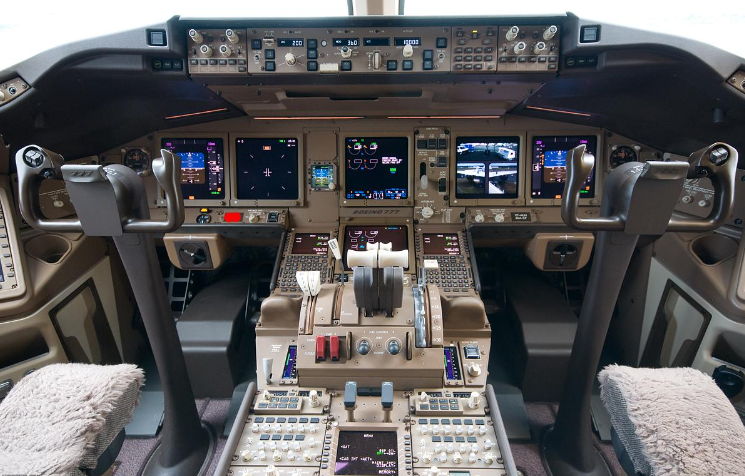
The 777 engines are simply massive, with the GE-90’s generating upto 115,000lbs of thrust, per side.

When cleared for take-off we run the engines to 55% N1 and allow them to stabilise. They are very large and thrust takes several seconds to build, especially from idle power. As well as being kinder to the engines to allow them to spool (rather than opening them up to the maximum immediately) if one engine spools slightly faster than the other, any asymmetric thrust will be balanced before opening them up to take off thrust. This is important as at low speeds corrections with the rudder are aerodynamically ineffective.

Additionally, stabilising the engines gives the pilots a chance to examine engine parameters at a fair thrust loading, to establish that they are behaving normally and it is safe to continue. In particular we are checking there are no surges, or disturbances of airflow which would indicate unseen compressor or turbine damage and that fuelling is normal.

This standard procedure also caters for a wide variety of conditions, for example icing or rain and high winds.

In some aircraft, other systems become active after the power levers reach a certain position: for example on the DHC8-Q400 the auto-feather system arms after a PLA (power lever angle) of around 50 degrees, so a pause to establish this has happened (and a call from Pilot Monitoring, ‘stable, auto-feather armed’) is also made.

Related Posts

What’s it like inside an aircraft carrier during a heavy storm?

During my time on a carrier, we went through a hurricane not once, but twice. We were in the Atlantic returning to our home port but first, we…

If the Soviets had decided to push the Allies out of Western Europe at the end of WW2, could they have done it?

Stalin asked Marshal Zhukov that very question in 1945. His answer: No. Westerns have a myth about the Red Army being this enormous inexhaustible machine that steamrolled its…

How long can an Ohio-class submarine stay submerged?

The Ohio-class nuclear submarine was designed for extended strategic deterrent patrols. Each submarine is assigned two complete crews, called the Blue crew and the Gold crew, each typically serving…

Why is the F-35 terribly flawed but the F-22 wasn’t?

The F-35 has been clubbing F-15s, F-16s, F-18s, like baby seals in recent exercises. And In Red Flag 17–1 when the F-35 was declared out of weapons, the…

How large can an aircraft carrier be made to accommodate as many aircraft as possible?

HMS Habakukk was planned to be 2000′ long, 300′ wide, and able to carry 200 planes including heavy bombers! While it was theoretically possible to build it, the…

Which US Navy jet was the most difficult or the easiest to land on the Aircraft Carrier?

Most difficult or worst? Almost certainly the Voight F7U Cutlass. 25% of the production run was lost to landing accident. Carrier Captains started ordering them off their ships…