Not an ancient technique, but related. The great chain of Constantinople’s harbor. It was a marvel of medieval engineering.
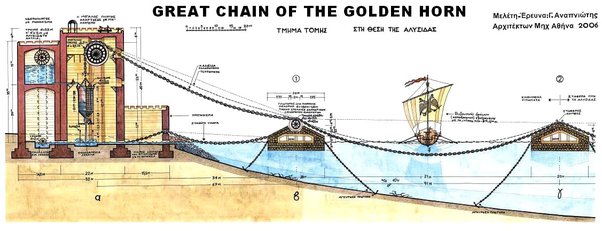
Illustration by Georgios Anapniotis.
For seven centuries, it was one of the key elements of the Queen of Cities’ elaborated system of defense and was only taken down once by the Venetians in 1203.
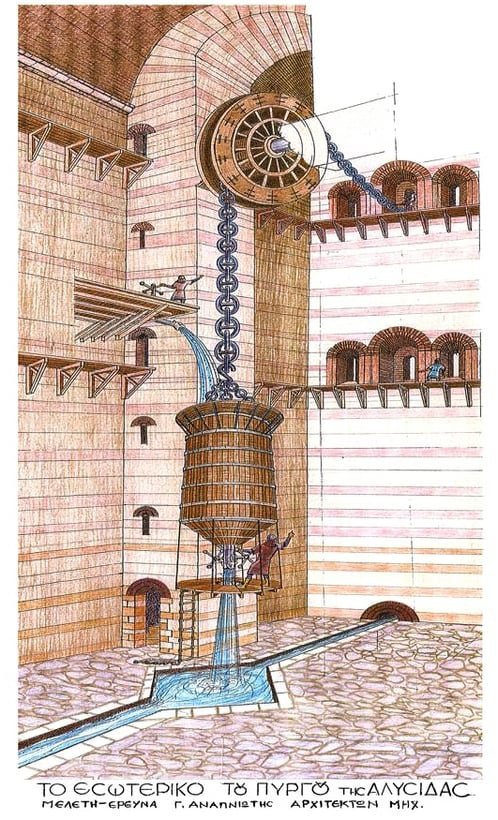
Illustration by Georgios Anapniotis.
With a length of 750m between the Kenthenarion tower and the Kastellion tower, the legendary colossal chain-boom was operated mechanically: it took only a few minutes to open or close to allow safe passage in and out of the deep-water Golden Horn.
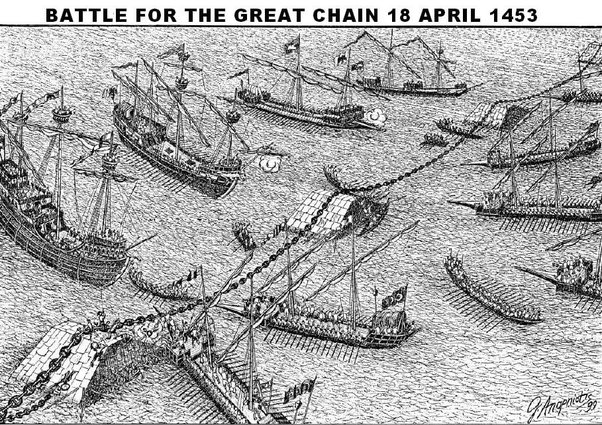
For starters, Constantinople had excellent natural defenses: It was built on a triangular promontory of seven hills and completely surrounded by a single high wall. It’s land side added another double wall and a moat. Its southern side was bounded by the fast current which swept down the Bosphorus. This made it almost impossible to beach a landing-craft and hold it in position while troops get ashore.
There were innumerable rocks and shoals which endangered boats not familiar with the waters. Across the northern deep water bay of the Golden Horn stretched a massive metal chain which prevented the passage of any unwanted ship. It was first designed and used during the Arab siege of 717 A.D.
The Chain consisted of a set of nine catenary curves, of which seven were permanently in place and two movable. According to calculation, between the two large suspension towers at each end, the Chain rested on 8 massive pyramidal floating pontoons anchored to the sea floor 30 meters below for stabilization.
Each of the chain’s elliptical iron link was 1,20 meters in length and weighted half a ton (one of these links was observed at the Tophane Arsenal in 1877 by Alexandros Paspatis). Each pontoon bore the load of 920 tons from the two chains.
Once in position, only the sections of the Chain closest to the towers were opened or closed according to the need, using a huge wheel, pulleys, and a giant 35-ton hollow counterweight operated by adding water (transported from a water tower and lifted up using a pump) or subtracting seawater. Only three people were needed to operate the mechanisms smoothly.
A handful of dromons fireships anchored behind the chain were enough to defend it in case the enemy would try to get close and attempt to break it. In 1203, the gallant Venetians had stormed the Galata Tower after its defenders ran away. The Crusaders simply lowered down the chain to enter the Golden Horn with their massive fleet.
The 2019 article by Georgios Anapniotis is a fascinating read, providing one can make abstraction of the blatant nationalistic overtone.
The author makes a valid point in claiming that the sections of iron chains exhibited in various Istanbul museums are not from the original Great Byzantine Chain. They are way too small for that. Instead, they could originate from the elements used to anchor the pontoons.
After two failed attempts at breaking the mighty Chain (although only 10 Byzantine and allied ships defended it), to bypass it, Mehmet II achieved the same feat Igor of Kiev’s Rus’ had done 5 centuries earlier with their longboats: His workforce carried part of his Navy overland, over the steep hill of Galata. On April 22, Constantinople’s defenders watched in terror as Amza Bey’s 70 light galleys were launched into the harbor.
When Constantinople fell on May 29th, 1453, some of the defenders and rich civilians tried to escape by sea from the Golden Horn, only to find out that they were now trapped behind the Chain, as the operators in the towers had either deserted, or had been killed.
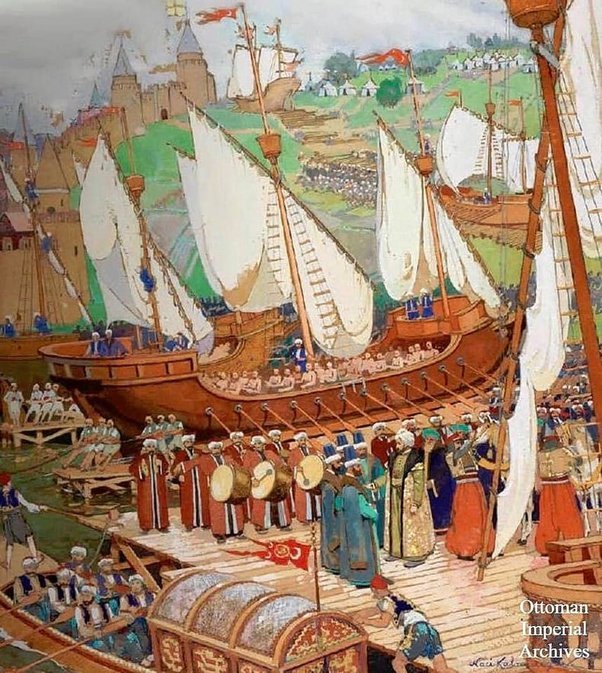
The 21-yearn old Mehmet II supervises the transport of a part of his fleet overland!