First, I don’t know if the probability of being struck by lightning is exactly 1 in 1 million, but let’s say it is. Fine: that’s the probability of you being struck by lightning. When you consider that there are 8 billion (and growing) people on Earth, the worldwide probability that somebody will be struck by lightning is much, much higher.
Given enough chances to occur, even improbable events become commonplace.
But you wanted to know if we have observed scientific events with an even lower probability. Yes we have.
Neutrinos are subatomic particles that interact with matter so weakly that they could pass through a meter-thick wall of lead without breaking a sweat. In any given second, about 100 trillion neutrinos pass through your body, and you are completely unaware of it because the vast majority of them never interact with your atoms.
In fact, if you even want to detect a neutrino, it’s fiendishly difficult.
Behold the Super-Kamiokande neutrino detector, located about 1000 meters (3300 feet) underground near the city of Hida, Japan.
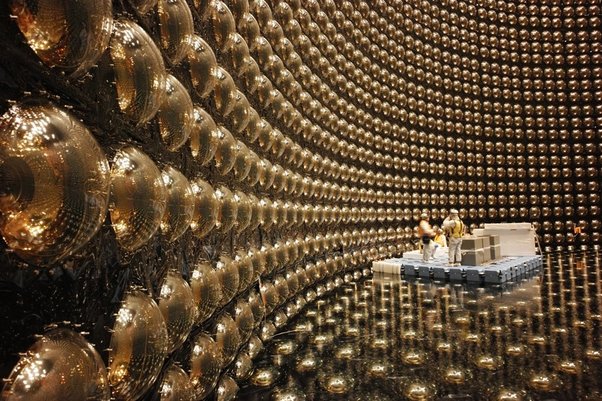
This dedicated neutrino detector was completed in 1996 and filled with 50,000 tons of pure water. The 13,000 photodetectors along the wall are meant to capture the fleeting evidence of neutrinos passing through the tank.
Remember when I said that about 100 trillion neutrinos pass through your body every second? How many neutrinos do you think pass through the Super-Kamiokande? I’ll give you a hint… it’s a lot more than 100 trillion.
And yet, the detector measures only about 30 neutrinos per day. Neutrinos are so difficult to detect that out of the untold zillions that pass through the detector in a 24-hour period, it only manages to snag a few dozen.
How’s that for rare?
Yes. Getting hit by a meteorite.
Most things that hit the atmosphere burn up on the way down, but it turns out that on a typical day about 17 are large enough to hit the ground. That’s far less than the number of lightning strikes in a day – about 8.6 million.
As such, in all of recorded history, only one person has ever been hit by a meteorite. Several have hit houses. One hit a car. One wiped out most of a forest in 1908 in Siberia, but killed no people. But only one has actually hit a person.
And that person survived. It just grazed her.
Now, about 65 million years ago, we got hit hard on the Yucatan peninsula and you can still see the crater. That probably killed a lot of animals, and eventually the resulting climate change killed huge numbers of species. But no people.