Why should it freeze? Contrary to popular misconception, space is not cold. Being a near-perfect vacuum, space itself has no temperature at all.
If a given object is in space but shielded from the Sun, it will lose heat through radiation and eventually it will become very cold – but that same object in space receiving direct sunlight, at least in the vicinity of the Earth, will become quite warm. (And hence the “rotisserie roll” maneuver conducted by various manned spacecraft, to try to keep their surface temperatures fairly even.)
If you release liquid (“room temperature,” say) water into space, it won’t lose heat rapidly enough to freeze (unless it comes into contact with a cold surface) before it evaporates into the vacuum.
Actually, as others have pointed out, the process of boiling away will at the same time cool the water to form ice crystals, but those will then quickly sublimate in the vacuum. So while there will be some ice produced along the way, the short-form answer is that the water effectively evaporates.
Contrary to science fiction scenes of things being frozen instantly in the “cold of space,” it is far from the truth. Think for a moment about the fastest and slowest ways to chill something. You can put something in your home freezer, but you come back in 20 minutes and it’s barely even feeling cold on the surface.
A BLAST freezer/chiller is faster. The difference is that cold air is circulated. Just as you feel colder when it is both cold AND windy outside, circulating cold air draws more heat from an object in a given amount of time and so freezes much faster.
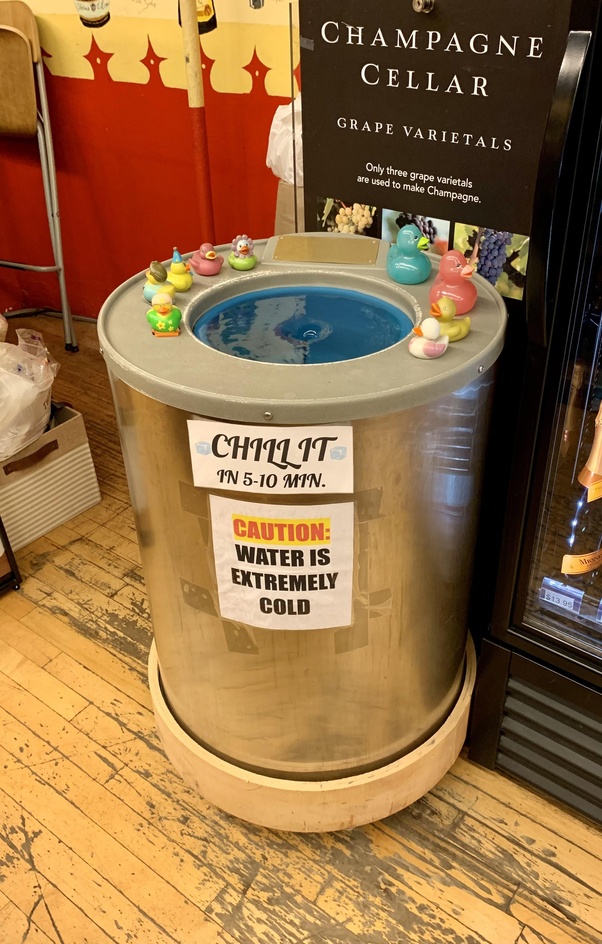
Even faster chilling or freezing can be accomplished by having something next to a material with a greater heat conduction index than air; there are wine bottle chillers that use a refrigerated liquid and chill wine bottles at a dramatically faster rate than in same temperature still air.
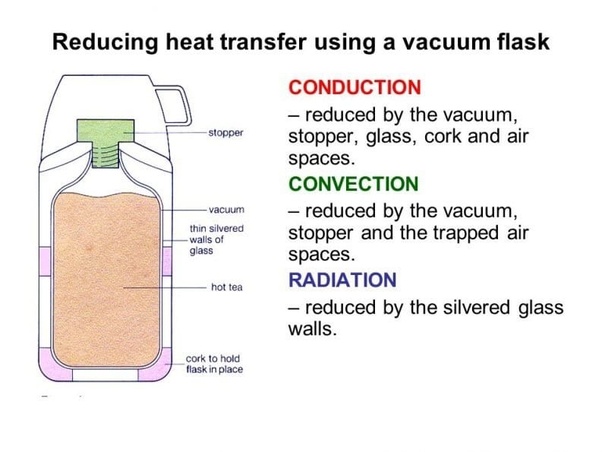
but now what is the WORST way to chill a liquid? Well pretty obviously if you put hot coffee in Thermos (vacuum bottle) and put it in the freezer, it will take far longer to freeze than just putting a cup of coffee in the freezer or pouring it on the inside frozen surface of the freezer.
Even after an hour in a freezer, hot coffee in a good Thermos will still be hot.
The reason the vacuum bottle is so effective is that the hot contents is surrounded by a space with a vacuum. There is little air in the vacuum space to absorb heat and transfer it out of the bottle. And the same is true in space.
Without air, it is very DIFFICULT for anything to lose heat as everything is in effect in a vacuum bottle of its own. This has huge implications for instance for using such things as nuclear reactors in space as cooling them to keep them from overheating is a huge problem.
So quite simply, boiling happens first, but not boiling due to heat but rather boiling in the sense of changing to vapor… due to low pressure.
Thanks to a couple commenters below who noted that the sudden change to vapor due to the change of pressure releases a great amount of heat, enough to freeze the steam droplets. This is NOT due to the “cold of space” which would be quite slow. This is akin to the process that causes freezing temperatures in air conditioners.
Inside them, refrigerant is compressed in one part of the A/C which produces heat. The heat is dissipated by passing the hot liquid through a radiator with a fan blowing on it. Then on the inside/air conditioned space, the compressed gas is released to a lower compression space which absorbs heat, causing freezing temperatures.