
That was the thought a long time ago until this guy noticed something:
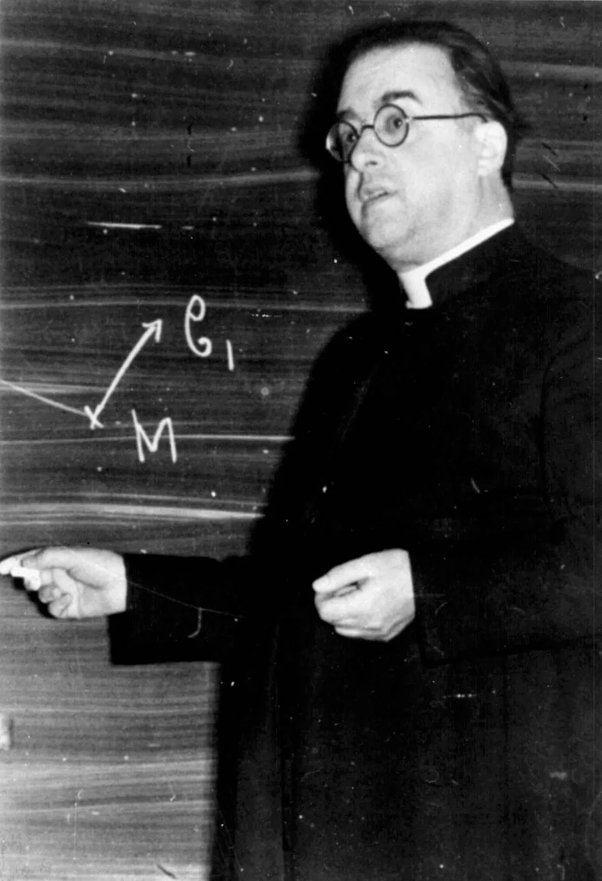
George Lemaitre. Astronomer, mathematician, physicist and priest. He noticed something interesting.
Objects were moving away from us. And the further away they were the faster they were going. So he worked backwards and said, “if they’re moving away from us then they must have been closer in the past”.
Up until then the model of the universe was the “Steady State” which was that the universe was always there and had no beginning. The scientists of that day agreed and dismissed George’s idea because it was, and I love this bit, “too close to creationism”.
That’s right. Scientists thought the idea of a starting point made it too similar to a religious concept. The fact that a priest brought it up made it even more suspect. But like all good scientists they examined the evidence, did the work and figured out, “yeah, he’s right”. Except of course all scientists are in agreement that it started 13.77 billion years ago and not less than 10,000 years as some religious types think.
This is why we can’t have nice things. Religious people ALWAYS have to screw it up for the rest of us.
Here’s the big problem, and Stephen Hawking pointed it out in his doctoral thesis when he calculated the nature of the early universe.
And, in a nutshell, it’s the laws of the conservation of energy – the first and second laws of thermodynamics.
To sum up, in a closed system, and the universe is a closed system (pretty much nothing else is – the universe is a perfect closed system), you can’t get “extra” energy at any point, and energy tends to go from useful (fire) to non-useful (heat). The amount of total energy (and that includes potential energy within atoms from fusion and fission) is a constant, but it becomes less useful over time.
Hawking pointed out that if the universe had existed forever, it’s very unlikely that “now” there would be any useful energy at all. Later in his career, he and others worked out that given the total energy content of the universe, all the useful energy would be exhausted over several trillion years.
We do observe that energy quality is dropping – stars explode and turn into other elements, they exhaust their energy over time, they slowly turn from mostly hydrogen to an increasingly large amount of helium. In other words, keeping the universe going needs energy and, luckily, it has a lot of it.
What we don’t see is “infinite energy” or “new energy”. All the evidence points to the universe having exactly the same amount of energy now than it did at the beginning, just in less useful form. But the loss of useful energy is inevitable. Over very long time frames, even super-massive black holes dissolve into nothingness.