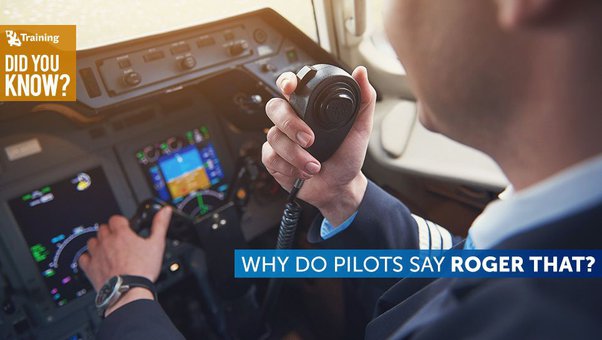
Pilots use the phrase “Roger that” when they are in the air. Have you ever thought who the Roger is and why his name appears in the conversations between pilots?
The reason goes back to the very first flights.
The first plane flight by Wright brothers dates back to 1903. Then they used flares, hand signals and coloured paddles to communicate while the plane was in the air as there was no such thing as radio communication.
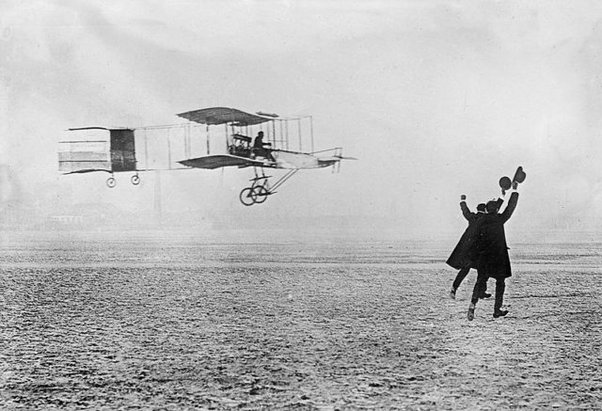
The aviation technologies developed and pilots started to use the Morse code to communicate in approximately 1915 when air-to-ground voice transmission became possible. Back then they confirmed that the message was received by signaling the letter R in the Morse code.
Later the communication switched to radio and pilots continued using the letter “R”, but started to use the word “roger” to mean received. Why “roger”? As not all pilots could speak English back then, the International Telegraph Union back in 1927 decided that “Roger” would be an easier command than “received”.
ROGER stands for Received Order Given, Expect Results. This phrase does not mean the agreement but just the signal that the entire message was received.
Following several air traffic accidents, the International Civil Aviation Organization (ICAO) suggested English should be the international language of aviation. Therefore, all pilots and air traffic controllers must have at least ICAO Level 4 of The English Language.
Moreover, in aviation, some English words have some special meanings that are different from the standard English. If you want to understand the secret pilot language, you must learn the international phonetic alphabet. Moreover, there is a list of words with special meaning on flights. For example, “Roger” meaning “received”; “affirm” meaning “yes”; “approach” meaning “coming to land”, etc.
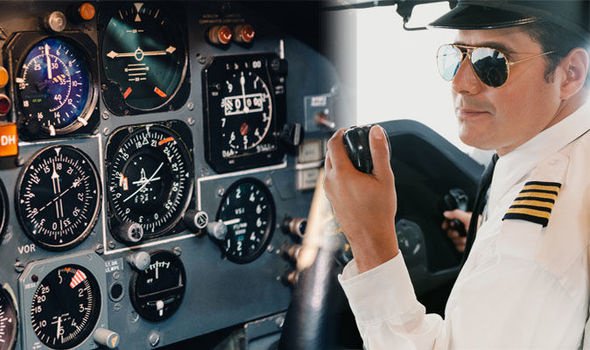
The language of aviation is changing and nowadays following the current spelling alphabet pilots use “Romeo” instead of “Roger”.
While the language of aviation is continually changing, pilots are required to pass strict language tests in order to fly planes safely.
Roger is a current radiotelephony ‘proword’ which is a word used to represent a longer phrase.
Roger means, very specifically: “your message has been received and understood.”
Wilco means: “your message has been received and understood and I will comply.”
Affirm (note, NOT affirmative) simply means yes, but is clearer over the radio.
Negative means no.
Over means I’ve finished speaking and expect a reply.
Out means I’ve finished speaking and do NOT expect a reply.
Roger Wilco over and out means I am not a pilot.
The terms “Roger” and “Wilco” are not longer used in modern aviation phraseology.
If the tower clears me to land, I repeat the phrase “Cleared to land runway 24.”
What’s good about that is that the tower knows that exactly what he said is what I heard, and what I am going to do. “Roger” would not give that extra chance to correct an error, in case I heard the instructions incorrectly.
Same for “Wilco” not giving a chance to correct an error in hearing or understanding. If ground control says “Cessna 44 Golf cleared to runway 24 via Alpha one, Sierra, Bravo Four, Echo, hold short runway 33 Left.”
If I were to say “Roger” then there is a chance I might have gotten this clearance wrong and end up taxxing where I should NOT be, and that could be a serious safety issue.
So the correct practice is to repeat the whole clearance (a “readback”) and then ground knows I have it exactly right.