
As the late Douglas Adams pointed out: “Space is big. Really big. You just won’t believe how vastly, hugely, mind-bogglingly big it is.”
So here is the thing: in the Oort cloud, the average distance between comets is estimated around 16 astronomical units (AU). That is, 16 times the distance between the Earth and the Sun. So that’s one comet every 2.4 billion kilometers.
And comets, of course, are pretty small. The nucleus of a comet has a diameter of 10 km or so. That’s less than 0.1% the diameter of the Earth.
By way of comparison… imagine reducing a comet to the size of a golf ball. Then, the average distance between golf balls would be about 10,000 km. So take the entire Eurasian and African land masses together and place a single golf ball somewhere at a random location. Now fire a bullet randomly at the combined Eurasian/African land mass. What are the odds that your bullet will hit the golf ball?
That’s how unlikely it is for the Voyagers to hit an Oort cloud comet on their way out of the solar system.
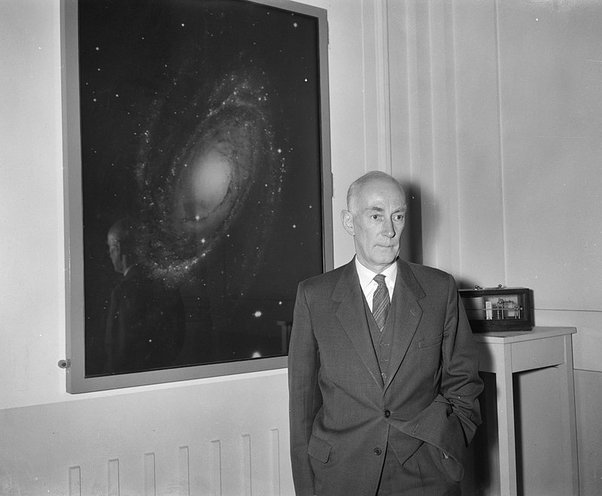
Jan Oort – 1900 to 1992
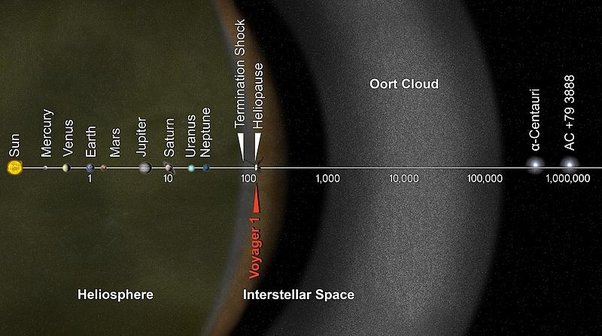
Oort Cloud. A shell of matter 2000 AU (0.03 light year) to 50,000 AU. (0.79 light years). A shell 2.065 cubic light years.
There are trillions of objects spread throughout this total volume. Total mass is 5x that of Earth!
So divide five Earths into a trillion parts and spread those parts evenly across 2.065 cubic light years!
Pretty empty. Each piece is more than 10 million km from another!
Going through the Oort cloud is like going through the Kuiper Belt or the asteroid belt!
There’s a chance you could hit something, but odds are, you’ll be on the look out and steer toward anything you see to get a good look at it!
New Horizons second flyby is just such an event! After passing the Pluto system the space craft adjusted course to flyby a Kuiper Belt Object KBO 2014 MU69. Its a binary system with two objects orbiting one another. The probe will encounter it on 1 January 2019.
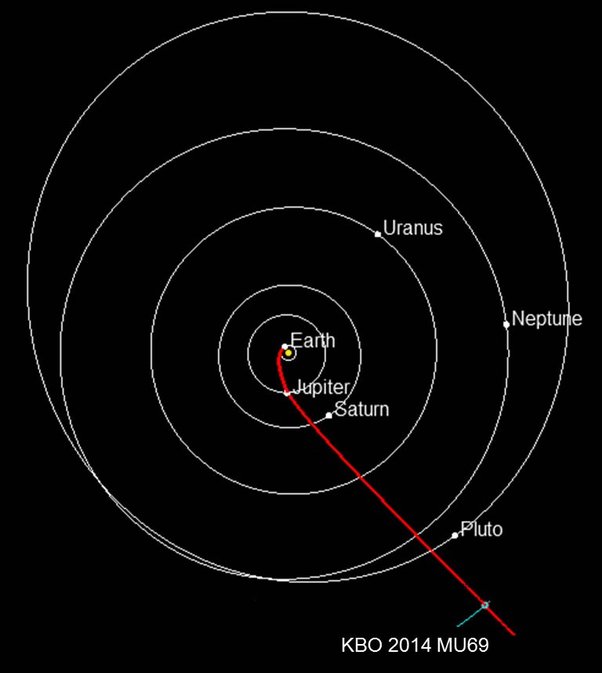
At present New Horizons is 41.2 AU from Earth. At 660 AU the gravity field of the Sun focuses light of distant stars making a very large telescope objective! At 3.13 AU per year in November 2215 the probe could look back at the Sun and use this effect to magnify distant stars.
It is very likely that we will send a probe this distance long before that date!