At Celsius, water turns into ice below 0°, logical, right? However, the logic of Fahrenheit escapes me and why people continue to use it in the USA while just about the rest of the Western world uses Celcius.
Fahrenheit was created first (1724). Daniel Gabriel Fahrenheit invented the first accurate and reproducible thermometer. He wanted a 100° difference between the coldest temperature in winter and human body temperature. His coldest temperature was calculated in the Netherlands and he was slightly off when he calculated average human body temperature.
Years later in 1742, Anders Celsius noted that Fahrenheit thermometers were difficult to calibrate so he used the freezing point and boiling point of the most common substance, water, as the fixed points. He used 0 as the boiling point of water and 100 as the freezing point of water (some say this was to minimize the use of negative numbers).
The following year Jean-Pierre Christin reversed the two points in accordance with the concept that hotter temperatures should have higher values. He called the temperature scale Centigrade.
Unfortunately, when the metric system was invented in the 1790’s, the term centigrad was used to describe angles. This was a source of ambiguity and confusion. So, in 1948, the Centigrade temperature scale was renamed after Anders Celsius.
As for the United States, its Customary measurement system is a relic from before the American Revolution when they were a group of British colonies.
The metric system (SI) including the Celsius temperature scale is the common language of scientists and over 95% of the people in the world.
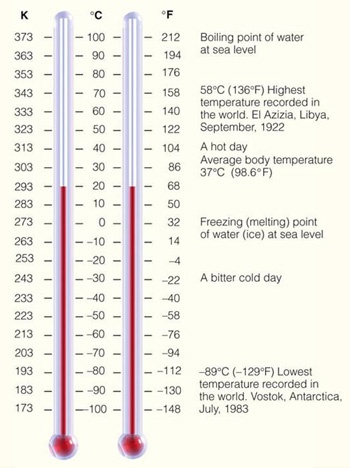
Gabriel Daniel Fahrenheit wanted to have zero at the lowest temperature which he was aware of, thus avoiding negative degrees. It was the brine of ammonium nitrate and water, whose eutectic point is at -17.77 deg C – this is zero Fahrenheit. This makes the freezing point of water as 32 deg F.
(He should have come to Finland – we have much lower temperatures here.)
He then chose the human body temperature as 96 degrees. Why 96? Because it is evenly divisible with 2, 3, 4, 6, 8, 12 and 16, while 100 is divisible only with 2, 5, 10, 20 and 25. This makes 100 deg F as 37.78 deg C and the boiling point of water as 212 deg F.
Fahrenheit’s thermometer was accurate, but incredibly difficult to calibrate. This is why alternatives for it were sought. In Sweden, Anders Celsius used the same liquid (water) for both 0 and 100 deg, to make the thermometer easily calibrable. He originally insisted his scale to measure weathers, so he set the boiling point as 0 and freezing point as 100, to avoid negative readings. But his students found the scale would be more useful if the points were interchanged.
In France, René Réaumur based his thermometer on liqueur making, and ethanol. He used 20% mixture of water and ethanol, setting his scale on freezing (0 deg R) and boiling (100 deg R) for this mixture. This makes 0 deg R for the freezing point of water and 80 deg R for the boiling point of water.
The Réaumur scale was originally adopted by France, Germany, Switzerland and Russia. It is obsolete today, but it still has some use in cheesemaking.
Fahrenheit is linked to human body temperature. It was meant that 90 is the normal body temperature (it’s not because the calculations were off, but it’s still fairly close). The rest are more of our experience of “hot” and “cold”. Close to 0 is very cold (and below 0 is extreme), 50 might be a bit chilly but alright, and above 90 is blistering hot.
Like many things, it’s the inertia that kept it being used in the US. Everyone’s already using it and it’s highly standardized everywhere, so changing it will cost actual money, easily in the hundreds of millions of dollars.
Of course, when it comes to some technical fields, they also use other units. Engineering sometimes use Rankine (the Kelvin equivalent of Fahrenheit scale) with the notable exception of aviation, which uses degrees Celsius. The sciences use SI units or any of their customary ones in their field.
The rest of the world already standardized to Celsius-Kelvin system because the Fahrenheit either never got introduced there or they want to standardize with everyone. Fahrenheit doesn’t make that much sense anyway.