A: Patience, young pup! James Webb Space Telescope is not online yet. July 12th is the date when it starts to deliver.
You seem to be referring to GN-z11, or some other ultra-deep field discovery. GN-z11 was discovered using a collection of observatiories: Hubble Space Telescope, Spitzer Space Telescope, Chandra X-Ray Observatory, XMM-Newton, and Herschel Space Observatory. In that data, the galaxy GN-z11 was found.
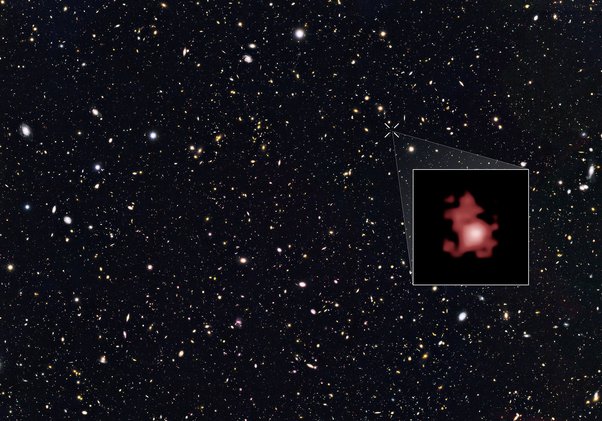
GN-z11 is the red blob. That’s as good image as we can get.
Q: That means that the light would have traveled for much longer than the age of the universe!
A: You are missing one crucial detail: space expands.
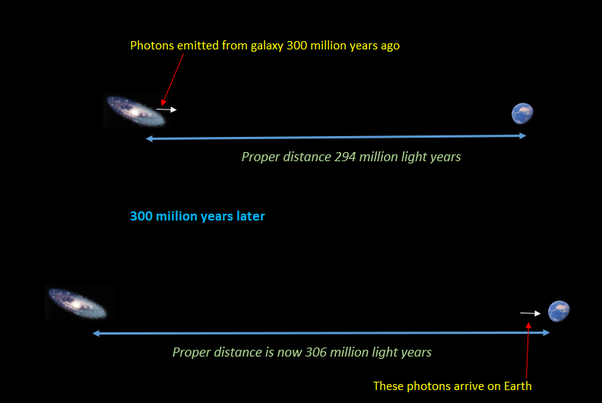
It works a bit like this: imagine holding a rubberband between your hands. At a certain point, someone drops an ant on it. The ant walks at 1 cm/second – no faster, no slower. But while it is walking, you are stretching the rubberband, so when the ant finally bites your thumb 13.4 seconds later, the point where the ant was placed is now 32 cm away from your thumb.
The same happens to light: the light from that galaxy took 13.4 billion years to reach us, since then, space has expanded, and the galaxy (or whatever remains of it) is now 32 billion light-years away. And since the space that light travels through expands and light still must move at the speed of light, it has to lose energy in other ways than going slower. So it becomes redshifted instead: the wavelength becomes longer, and the light is thus redder.
And that is where James Webb Space Telescope comes in: it is specialised in taking very detailed images in the red and infrared part of the spectrum. That means that when online, it can take very detailed images of galaxies even further away than GN-z11, and thus shed some light (pun intended) on the Dark Ages of the universe and the earliest stars.
So perhaps James Webb can take another look at GN-z11, and with the magic of shifting the colours in post-processing to compensate for the redshift, the image it takes may look a bit like this:
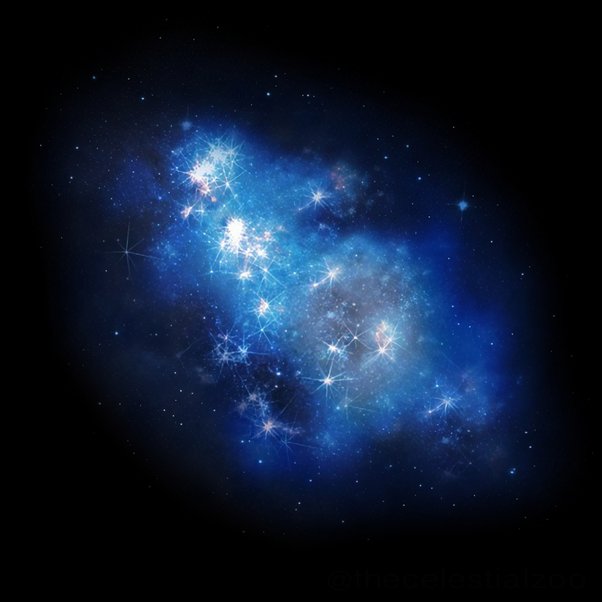
But alas, that is just an artist’s conception of GN-z11, and not the real thing.
So again, patience, young pup!
The point you’re missing is that the light that arrived here now was emitted by the galaxy (known as GLASS-z13) when it was located about 13.4 billion light-years away – this is called the light-travel distance. In fact, the image captured by JWST was emitted by the galaxy just 300–400 million years after the Big Bang. Edit: as some have commented, distance in cosmology is a complex issue. So, just to be clear, the proper distance of GLASS-z13, 13.4 billion years ago, was about 3 billion light-years (the actual value depending on cosmological parameters).
However, since the universe has been expanding since the Big Bang, GLASS-z13 kept receding from us with increasing speed (Hubble-Lemaître law). This implies that, when the light arrived here, the galaxy was way more distant, or about 33.3 billion light-years – known as the present proper distance.